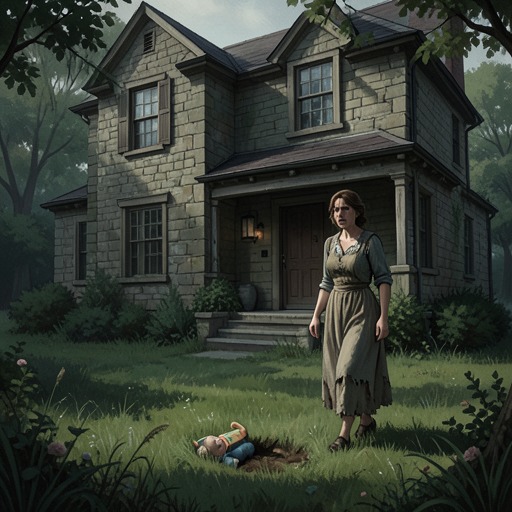
Clare introduces Henry to her grandmother
The Time Traveler's WifeClare introduces Henry to her grandmother, Elizabeth Meagram, during a walk across the Meadow to the clearing. The encounter makes their relationship legible to Clare’s family: Elizabeth learns that Henry is the man Clare expects to marry, witnesses his sudden disappearance, and voices the anxieties his condition raises about marriage and children. The scene joins a tender introduction to a sharp difference in how the two women imagine life with a time traveler.
The Walk to the Clearing
Clare accompanies Elizabeth toward the Orchard, taking her arm as they leave the edge of the Meadow. When they reach the path, Clare asks whether Elizabeth would prefer shade or sun; Elizabeth chooses sun, and they take the route through the middle of the Meadow toward the clearing. Clare describes what lies along the way, including birds startled from the bonfire pile and young oak trees planted in memory of Elizabeth’s brother, who was killed in the Second World War. At the middle oak, Elizabeth touches the trunk and greets it, a small act of remembrance before the walk continues.
As they cross a rise, Clare sees Henry standing in the clearing. He is still, tired, and graying, wearing a black overcoat against the bright Meadow. Elizabeth asks where the rock is so she can sit; Clare guides her there and helps her down. Although Elizabeth cannot see Henry, she senses someone’s presence and asks who is there. Clare initially says no one, postponing the introduction as she tries to decide how to explain what Elizabeth is encountering.
The Introduction
Henry quietly asks Clare to introduce them. Clare puts an arm around Elizabeth’s shoulders and identifies Henry as the friend she has told her about. Henry approaches and offers his hand; Clare places Elizabeth’s hand in his and gives Henry her grandmother’s name. The introduction is therefore mediated by Clare: she brings the two together physically and supplies the connection that makes the unexpected visitor comprehensible.
Elizabeth recognizes the significance of the meeting and tells Henry that Clare has said she will marry him. Henry confirms that they intend to marry in a few years, after Clare has finished school. Elizabeth responds in the language of family custom: in her day, a gentleman would come to dinner and meet the family. She then extends the invitation herself, saying that a man who spends time in meadows with her granddaughter can come to the house to be inspected by Clare’s parents. Henry accepts the welcome in principle, but says he has a train to catch and cannot stay.
Disappearance and Its Explanation
Elizabeth begins to stop him, but Henry says goodbye to her and apologizes to Clare for leaving. Clare reaches toward him; before she can keep him there, he disappears. Elizabeth is left seated on the rock with her hands extended and an expression of bewilderment. The sudden departure changes the encounter from a conventional family introduction into direct evidence of the unusual condition Clare has been describing.
When Elizabeth asks what happened, Clare explains. Elizabeth lowers her head and twists her arthritic fingers before concluding, matter-of-factly, that Henry must be a demon. Clare answers that she has considered the possibility, but insists that Henry is good and does not feel demonic to her. Elizabeth’s response does not simply reject Henry: she is trying to name an event that exceeds ordinary explanation, while Clare draws on her own experience of him to distinguish his character from the frightening appearance of his disappearance.
Marriage, Children, and Unequal Futures
Clare tells Elizabeth that Henry’s doctor thinks he may represent a new kind of human, perhaps a next step in evolution. Elizabeth finds that possibility no more reassuring than the idea of a demon. Her concern turns from the immediate shock of the disappearance to what marriage might mean for Clare and for any children they might have. She imagines children who could appear in another week and return before breakfast, making Henry’s condition a question of family life rather than merely a marvel.
Clare answers with excitement, comparing the imagined adventures to those of Mary Poppins and Peter Pan. Elizabeth counters that fairy-tale adventures belong to the children, while mothers must stay home and wait for them to return. Her distinction gives the scene its central tension: Clare sees time travel as an exhilarating prospect, while Elizabeth considers the waiting and responsibilities it could impose on a family. The meeting offers no resolution, but it establishes that Clare’s commitment to Henry is already being tested against the ordinary expectations of kinship, marriage, and parenthood.
Place in the Larger Narrative
The encounter is told by Clare and belongs to a novel that places dated episodes from Henry’s and Clare’s lives beside one another, rather than presenting their shared history as a single uninterrupted chronology. Elsewhere, their ages and the dates attached to scenes show how an encounter can belong to different points in each person’s timeline. Here, the event’s focus remains the family introduction: Henry is not a stranger to Clare, but to Elizabeth he arrives as both a prospective husband and someone whose presence cannot be secured even through the most conventional welcome.
The clearing makes that contradiction visible. Clare leads her grandmother through a familiar landscape and supplies descriptions where Elizabeth cannot see; Henry stands before them, is introduced by name and future promise, then vanishes before he can be inspected at home. Elizabeth’s questions and warnings give social shape to the consequences of his condition, while Clare’s insistence on his goodness keeps the encounter grounded in intimacy rather than spectacle.